Connect generator
Attach the generator leads to the DC system and ground, then select the voltage level for the site.

Trace inadvertent grounds on live DC systems with low-frequency signal injection and directional current clamps.
PITE3836 helps maintenance engineers follow a 10 Hz test signal through busbars, branches and loads, then compare direction, phase angle and signal strength to isolate the physical fault point without normal circuit shutdown.
The signal generator injects a small directional low-frequency current into the faulted polarity. The handheld receiver and current clamps follow that signal from the main bus into downstream branches, helping technicians identify where leakage leaves the DC circuit and returns through ground.
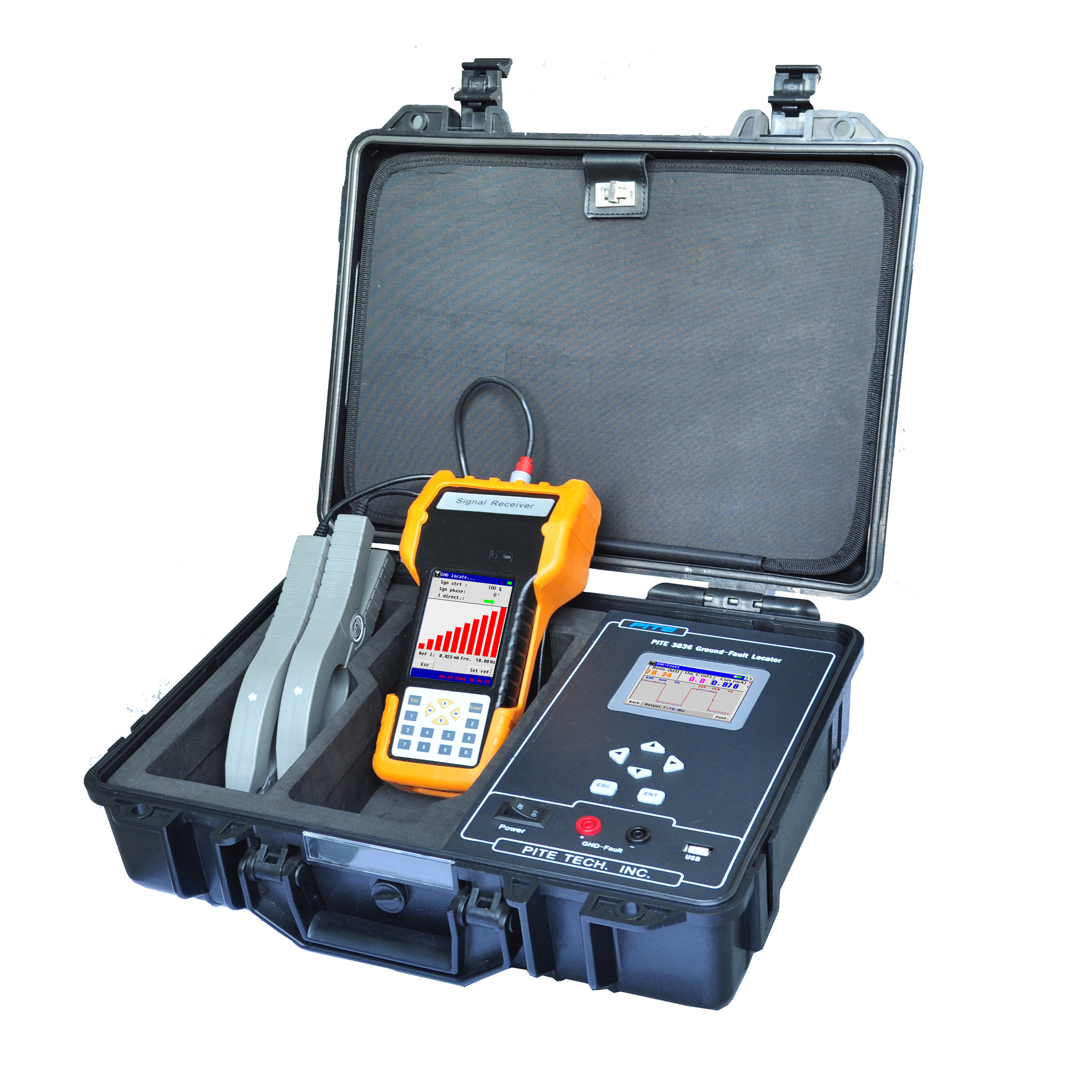

The receiver indicates current direction as clamps move along the bus and each branch. Before and after the grounding point, signal strength and phase angle change clearly enough to confirm the faulted section.
Attach the generator leads to the DC system and ground, then select the voltage level for the site.
Use the receiver clamp on busbars and feeders to find where the 10 Hz signal continues.
Move branch by branch, comparing direction, phase angle and relative signal strength.
Verify the section where the signal drops or reverses before isolating the faulty load or cable.
Battery and DC control systems may keep operating after the first inadvertent ground, but the system becomes vulnerable to overheating, nuisance trips, reduced battery capacity and unsafe working conditions. PITE3836 is built for the moment when the alarm is known, but the exact location is not.
The locator combines a controlled signal source, dual clamp measurement and DSP filtering so technicians can keep moving through a live plant instead of opening circuits one by one.
Key parameters are organized from the PITE3836 product introduction and current product page. Confirm final configuration and accessories with PITE before ordering.
| Output voltage | 24, 48, 110, 220, 500, 1000 VDC |
|---|---|
| Output frequency | 10 Hz |
| Output current limitation | 5 mA or unlimited, maximum 25 mA |
| Fault location sensitivity | ≤ 1 MΩ |
| Current detection sensitivity | AC/DC circuit: ≥ 0.5 mA |
| Quick search clamp | 55 mm diameter, 60 mm jaw opening |
| Current sensor | φ8 and φ20 |
| Display | Backlit color LCD |
| Power requirements | 8.4 VDC Li-ion battery |
| Operating environment | -5°C to 40°C (23°F to 104°F) |
| Dimensions | 360 × 260 × 135 mm (14.2 × 10.2 × 5.3 in) |
| Weight | 7 kg (15.4 lb) |

PITE3836 is supported by a Shenzhen manufacturer with in-house R&D, production, sales and customer service capabilities for intelligent battery and DC power maintenance equipment.
Download the product introduction with specifications, wiring concept and field test visuals, or send your DC system details for model and accessory advice.
These answers summarize the current product guidance for DC system maintenance teams.
No. PITE3836 is designed for DC systems and DC ground fault location.
The generator injects a low-frequency signal into the DC bus with respect to ground. The receiver traces that signal with current clamps, using direction, phase angle and strength changes to move toward the faulted branch.
For normal fault tracing, the locator is used online with a very low output current, so maintenance teams can locate faults without disconnecting the electrical installation.
Both units use rechargeable batteries and can be charged with the included power supplies for 110/220 VAC, 50/60 Hz input.
The rechargeable batteries last approximately 4 hours in normal use.